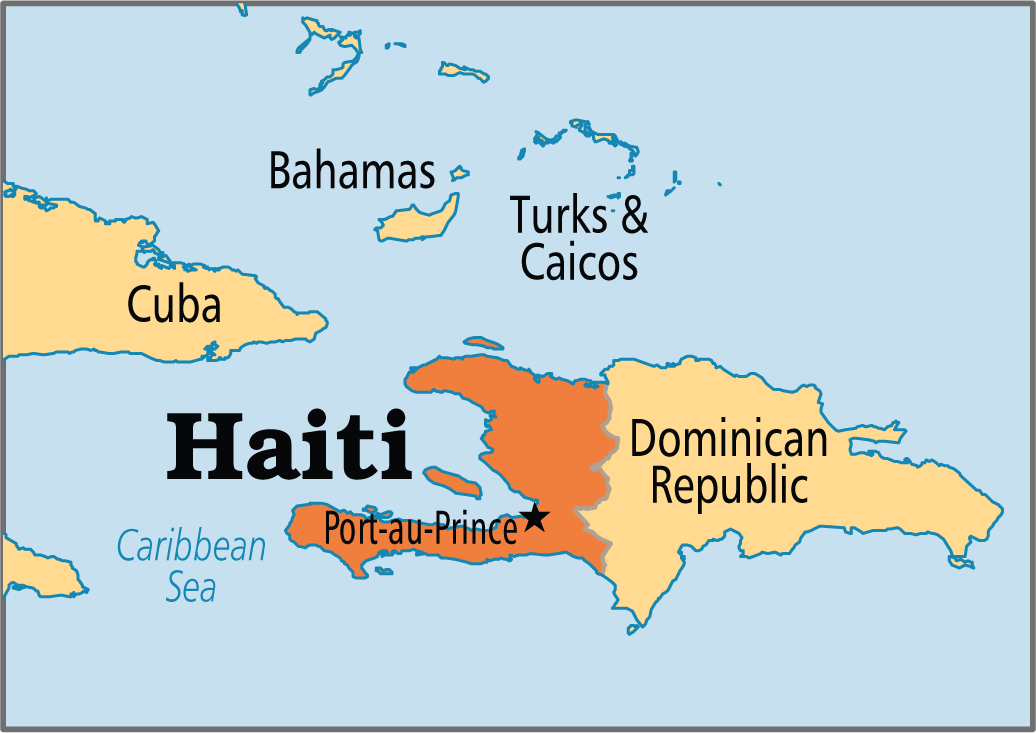
Haiti, or the Republic of Haiti, is a country located next to the Dominican Republic, with a population of roughly of 10.8 million people. Haiti, while known for its beautiful mountains and crystal blue water and breathtaking beaches, unfortunately has bad luck with natural disasters. In 2010, Haiti was ravaged by a 7.0 magnitude earthquake, which had killed over 220,000-300,000 people and left up to 1.6 million homeless. Even though this incident occurred in 2010, and gained international attention and help, the people of Haiti are still in the process of recovering, and a good chunk of their budget goes into rebuilding efforts. However, due to political trouble and international pressure, Haiti is not doing so well anymore.
As of 2013, Haiti has a score of 59.2 on the Gini Index, which measures the wealth distribution among all individuals within a country. On the Gini Index, a score of 0 would mean that wealth distribution is absolute equality, while a score of 100 means absolute inequality for wealth distribution. On the FSI Index (Fragile State Index), which looks at a country’s vulnerability to fall into chaos. On the FSI, Haiti ranks 12th out of 178 countries, proving to be a very unstable state. Their total at this time is 102 out of 120, which can only mean that Haiti is a state in which almost anything could change the country drastically.
As of right now, there is political unrest in the world because of Venezuela and their conflicting “presidents”. The conflict is between two different parties, one which claims that Juan Guaidó is the rightful president, while the other side claims that Nicolas Maduro is the rightfully elected president. Recently, Haiti joined the side of the US, Canada, and Colombia and other countries in condemning Maduro before he began his next six-year term. According to the Haitian Times, “19 OAS nations voted “not to recognize the legitimacy” of Maduro”, after being accused of conducting a sham election, through the regime-controlled National Electoral Council. Many accuse Haiti’s president, Jovenel Moïse, of succumbing to pressure from the US to join their side and support Juan Guaidó.
Recently, President Jovenel Moïse removed two top government officials who were involved in a recent corruption scandal. The cabinet Chief and the secretary general of presidency were both removed after being linked with Petrocaribe, along with 15 other government officials. This came after thousands of people protested outside of Port-au-Prince, which is the capital of Haiti. The protest comes after a demand for the accounting of nearly $2 billion, which have allegedly been misused by from an oil program, which was set-up to help rebuild Haiti’s economy after the 2010 earthquake.
More importantly, the Haitian government has asked for security agencies to seek out and arrest those who caused a two-day general strike, which was done in an effort to force President Jovenel Moïse out of office. The Democratic and Popular Movement (DPM), made up of 20 political parties that oppose the current party in charge. These public demonstrations call for President Moïse to step down after the Petrocaribe scandal, accusing him of “not investigating allegations of corruption in the previous government”. According to sources close to the President say that he has no plans to step down from these accusations, but rather find the sources of the accusations and bring them to justice.
The country of Chile has repatriated almost 170 Haitians, who have volunteered to return home due to a humanitarian plan. So far, 677 Haitians have returned due to this humanitarian plan, with the help of Chile. Chilean Under-Secretary of the Interior, Rodrigo Ubilla, said that over 1,817 people have volunteered to return home, which includes 1,805 Haitians, 46 Colombians, 12 Venezuelans, and 5 Cubans. All those who have volunteered to return have been flown back on a Chilean Air Force plane.
 Peace Studies Blog